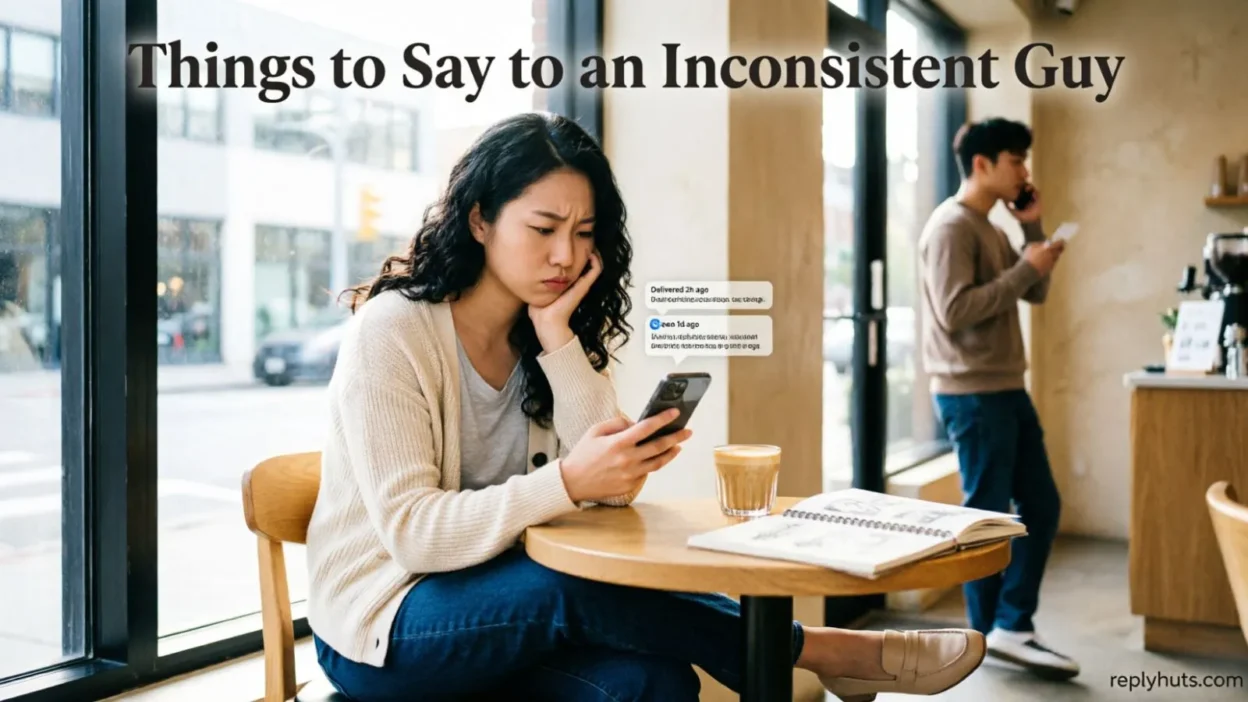
Dealing with an inconsistent guy can be frustrating, confusing, and emotionally exhausting.
One day he seems interested, attentive, and engaged, and the next day he disappears, sends mixed signals, or acts distant.
If you’ve ever wondered what to say to an inconsistent guy without sounding needy or confrontational, you’re not alone.
The right words can help you communicate your expectations, express your feelings, and determine whether he’s genuinely interested or simply inconsistent by nature.
In this guide, you’ll find practical things to say to an inconsistent guy, along with examples, alternatives, and communication tips that encourage honesty, clarity, and mutual respect.
1. “I’ve noticed our communication is a little inconsistent.”
Best for: Starting an honest conversation
Alternative: “Our communication seems on and off lately.”
Examples:
- “I’ve noticed our communication is a little inconsistent lately.”
- “Sometimes we talk a lot, and other times I don’t hear from you for days.”
This statement opens the discussion without sounding accusatory.
2. “Can you help me understand what’s going on?”
Best for: Seeking clarity
Alternative: “I’d like to know where your head is at.”
Examples:
- “Can you help me understand what’s going on between us?”
- “I’d appreciate some clarity about where things stand.”
A calm question often gets better results than assumptions.
3. “I value consistency in relationships.”
Best for: Setting expectations
Alternative: “Consistency is important to me.”
Examples:
- “I value consistency in relationships.”
- “Regular communication matters a lot to me.”
Be direct about your needs without making demands.
4. “Are you genuinely interested in getting to know me?”
Best for: Determining intentions
Alternative: “What are you looking for right now?”
Examples:
- “Are you genuinely interested in getting to know me?”
- “I’d like to know if we’re on the same page.”
This can prevent unnecessary confusion.
5. “Mixed signals are hard for me to understand.”
Best for: Addressing confusion
Alternative: “I’m getting different messages.”
Examples:
- “Mixed signals are hard for me to understand.”
- “I’m not sure how to interpret your actions lately.”
Honesty can encourage a more transparent response.
6. “I’d rather have honesty than uncertainty.”
Best for: Encouraging openness
Alternative: “I appreciate straightforward communication.”
Examples:
- “I’d rather have honesty than uncertainty.”
- “Please be direct with me, even if it’s difficult.”
Clear communication builds trust.
7. “What does consistency look like for you?”
Best for: Understanding his perspective
Alternative: “How do you usually communicate in relationships?”
Examples:
- “What does consistency look like for you?”
- “How often do you normally stay in touch?”
People have different communication styles.
8. “I don’t want to guess how you feel.”
Best for: Asking for emotional clarity
Alternative: “I’d appreciate more direct communication.”
Examples:
- “I don’t want to guess how you feel.”
- “It would help if you expressed your intentions more clearly.”
This reduces misunderstandings.
9. “I deserve clear communication.”
Best for: Reinforcing self-respect
Alternative: “Clear communication is important to me.”
Examples:
- “I deserve clear communication.”
- “I want a connection built on openness.”
Healthy boundaries are attractive and necessary.
10. “Your actions don’t always match your words.”
Best for: Pointing out inconsistency
Alternative: “I’m noticing some disconnect.”
Examples:
- “Your actions don’t always match your words.”
- I’m confused because what you say and do seem different.
Focus on observations rather than accusations.
11. “Are you busy, or are you losing interest?”
Best for: Direct clarification
Alternative: “Has something changed recently?”
Examples:
- “Are you busy, or are you losing interest?”
- “I’d rather know the truth than wonder.”
This invites honesty.
12. “I need a little more reliability.”
Best for: Expressing needs
Alternative: “I’m looking for more consistency.”
Examples:
- “I need a little more reliability.”
- “I’d feel better with more consistent communication.”
State needs confidently.
13. “If you’re unsure, it’s okay to say so.”
Best for: Reducing pressure
Alternative: “You don’t have to pretend.”
Examples:
- “If you’re unsure, it’s okay to say so.”
- “I’d rather know where you stand.”
This makes honesty easier.
14. “I don’t chase people.”
Best for: Establishing boundaries
Alternative: “Effort should go both ways.”
Examples:
- “I don’t chase people.”
- “I believe communication should be mutual.”
Healthy relationships involve equal effort.
15. “I’m looking for something stable.”
Best for: Discussing relationship goals
Alternative: “I want a dependable connection.”
Examples:
- “I’m looking for something stable.”
- “Consistency is part of what I need.”
Be clear about your standards.
16. “Do you have the time and energy for this?”
Best for: Assessing availability
Alternative: “Are you able to invest in this connection?”
Examples:
- “Do you have the time and energy for this?”
- “I want to know if this fits into your life.”
Timing matters in relationships.
17. “I feel confused when communication suddenly stops.”
Best for: Expressing feelings
Alternative: “The silence leaves me uncertain.”
Examples:
- “I feel confused when communication suddenly stops.”
- “I struggle when I don’t know what’s happening.”
Use “I” statements to avoid blame.
18. “What are your intentions with me?”
Best for: Getting direct answers
Alternative: “Where do you see this going?”
Examples:
- “What are your intentions with me?”
- “I’d like to understand your expectations.”
Simple and effective.
19. “I appreciate consistency more than grand gestures.”
Best for: Explaining priorities
Alternative: “Small efforts matter most to me.”
Examples:
- “I appreciate consistency more than grand gestures.”
- “Reliability means more to me than occasional attention.”
Consistency builds trust.
20. “I don’t want a one-sided connection.”
Best for: Addressing imbalance
Alternative: “I need mutual effort.”
Examples:
- “I don’t want a one-sided connection.”
- “Relationships work best when both people participate.”
Mutual investment is important.
21. “Can we communicate more openly?”
Best for: Improving communication
Alternative: “I’d like us to be more transparent.”
Examples:
- “Can we communicate more openly?”
- “I think honesty would help us both.”
A collaborative approach works well.
22. “I need actions, not just promises.”
Best for: Holding him accountable
Alternative: “Consistency matters more than words.”
Examples:
- “I need actions, not just promises.”
- “I value follow-through.”
Actions reveal intentions.
23. “I want someone who shows up consistently.”
Best for: Stating standards
Alternative: “Reliability is attractive to me.”
Examples:
- “I want someone who shows up consistently.”
- “Dependability matters in relationships.”
Confidence is key.
24. “Are we moving forward or standing still?”
Best for: Relationship evaluation
Alternative: “What’s the direction here?”
Examples:
- “Are we moving forward or standing still?”
- “I’d like to know where this is headed.”
Clarify the future.
25. “I respect your space, but I also need communication.”
Best for: Balancing needs
Alternative: “Both independence and communication matter.”
Examples:
- “I respect your space, but I also need communication.”
- “I understand being busy, but updates help.”
Balance is healthy.
26. “I can’t build trust on uncertainty.”
Best for: Discussing trust issues
Alternative: “Consistency helps me feel secure.”
Examples:
- “I can’t build trust on uncertainty.”
- “Trust grows when communication is steady.”
Trust requires reliability.
27. “I need to know if we’re on the same page.”
Best for: Relationship alignment
Alternative: “Can we talk about expectations?”
Examples:
- “I need to know if we’re on the same page.”
- “I’d like clarity about what we’re building.”
Alignment prevents disappointment.
28. “I don’t want to settle for confusion.”
Best for: Protecting your peace
Alternative: “Clarity is important to me.”
Examples:
- “I don’t want to settle for confusion.”
- “I prefer certainty over mixed signals.”
Know your worth.
29. “If you’re interested, show me.”
Best for: Encouraging action
Alternative: “I’d like to see consistent effort.”
Examples:
- “If you’re interested, show me.”
- “Actions speak louder than words.”
A fair and reasonable expectation.
30. “I may need to step back if things don’t change.”
Best for: Setting consequences
Alternative: “I need consistency to continue investing.”
Examples:
- “I may need to step back if things don’t change.”
- “I have to protect my emotional well-being.”
Boundaries create healthy relationships.
FAQs:
What should I text an inconsistent guy?
Keep it simple and direct. Try saying, “I’ve noticed our communication has been inconsistent. Can we talk about it?”
Should I confront an inconsistent guy?
Yes, but respectfully. Focus on your feelings and observations rather than accusations.
Why is a guy inconsistent with communication?
He may be busy, uncertain about the relationship, emotionally unavailable, or simply have different communication habits.
How do I stop overthinking mixed signals?
Ask for clarity directly, observe actions instead of words, and focus on maintaining your own boundaries.
Should I keep talking to an inconsistent guy?
That depends on his willingness to communicate honestly and make improvements. Consistent effort is usually a positive sign.
Conclusion
Navigating an inconsistent relationship can be challenging, but clear communication can help you find answers faster.
These things to say to an inconsistent guy allow you to express your feelings, set healthy boundaries, and gain clarity about his intentions.
Remember that you deserve respect, consistency, and honest communication.
If someone continually sends mixed signals without making an effort to improve, it may be time to prioritize your own peace and move forward with confidence.